Early on
during our time in Israel/Palestine, we climbed up to a lookout point in
British Park and saw a lush green forest stretching out into the distance. It
was the kind of sight that usually inspires awe and makes you feel grateful to
those that had the foresight to preserve it. But within this park are the ruins
of two villages that were home to Palestinians forcibly removed by Israeli
troops in 1948. Since the villages are no longer visible, we photographed the
pine forest that was planted to hide their remains and found it epitomized the
misleading nature of the Israeli landscape.
There are
ruins throughout Israel. Some are ancient sites dating back to Biblical times, but
most of what you see today is more recent. They are the remains of over 400
villages destroyed by the Israeli military after forcibly removing 750,000
Palestinians from their homes during what
Israeli textbooks refer to as “The War of Independence” and the Palestinians
call the “Catastrophe” (al-Nakba). Their systematic destruction ensured that
the exiled Palestinians did not have a place to return to, an act Israeli
historian Ilan Pappe has identified as ethnic cleansing. The residents from these
villages, along with their descendants, are now living as refugees or exiles throughout
the world.
There is
not usually much left of these villages--a cornerstone, or evidence of terraced
farming, or more frequently cacti--but if you know what to look for, you begin
to see them everywhere. The sites on which they stood have been purposely
renamed. Many of the parks in Israel/Palestine, including British Park (named for
the funders who donated money to the Jewish National Fund for its creation), were
part of an intentional design to hide these ruins in benevolent, landscaped settings.
The JNF, working together with Israeli government, planted fast-growing
European pines to form these parks, simultaneously
covering the ruins of the villages and creating a familiar landscape for the new,
European immigrants. The Zionist expression “making the desert bloom” hides a dark
history.
This is the
narrative we found in Israel/Palestine repeatedly — the history that has been
purposely buried is actually traceable in the land. We saw this in the ruins of
villages, hidden in plain sight. We also saw it in the untended olive trees present
throughout the West Bank. The trees look neglected, but they are a by-product of Israeli
policy in the Occupied Territories. Israeli settlements, the Separation Wall,
military checkpoints, and the segregated roads that criss-cross the West Bank have
made countless olive orchards inaccessible to the Palestinian farmers who depend
on them. These olive trees have been the main source of income for families that
have tended them for generations, and their products, a leading industry for
Palestinians. Palestinian ties to these trees run deep, and cutting off farmers
from their orchards is a powerful strategy of symbolic and economic discouragement.
These trees are beautiful in their untended wildness but their implication is
devastating.
While the
confiscated trees are a constant, sad feature of the Occupied landscape, the
settlements are the main instrument used to impose, expand and cement Israeli
control. The term “facts on the ground” is used to describe these housing
developments that are intended to establish permanent Israeli presence in
Palestinian territory, in effect negating Palestinian claims to their land. The
scale of some of these projects is so vast and the ongoing construction so blatant,
it’s difficult to reconcile that their existence is illegal under international
law.
Whether the
settlements are built in the style of North American suburbs, remote mountain
outposts, or populous cities, their placement on the hilltops overlooking Palestinian
villages in the valleys is menacing. This is both a symbolic and strategic
maneuver, a policy of physical and psychological dominance. The settlements are
now home to a half million Israelis and one of the main obstacles in any peace process.
They are islands of concrete and asphalt and their influence stretches beyond the
built structures, radiating out into the desert with circles of security fences,
roads, and checkpoints. Their presence fragments the West Bank, making it nearly
impossible for Palestinians to go to work or school, get medical care, or see
their families. The Occupation strangles Palestinian life, making it all but
unlivable, forcing those Palestinians who can to leave, and confining the rest
in what can only be called ghettos.
For the
majority of non-Palestinians, the dominant Israeli narrative invites one to
look away from recent history and current policies of encroachment. We made the
photographs in Facts on the Ground with
a large format camera, which describes the world in precise detail and compels
one to look at the landscape with great
deliberation. The photographs stay away from the dramatic violence of the
conflict that is frequently seen in the news, and reveal instead the enduring
ways the Occupation has transformed the land. Being both American and Jewish, Facts on the Ground is a reckoning with
our own nationalities and backgrounds. US foreign policy, ever favorable
towards Israel, is one of the factors that legitimizes and enables the
cruelties, small and great, that Israel inflicts on the Palestinian people.
Being Jewish means that Israel, the Jewish State, performs these injustices in
our name. The conflict in Israel/Palestine is often portrayed as timeless and deeply
complex, a portrayal which actively discourages scrutiny of recent and current policies.
And while the path to any future resolution will be complex, the history of the
conflict and the methods of the Occupation are more blatant than many want to
admit. They are stamped on the land.
Albedo
Zone
addresses questions of climate change through a series of black and white
photographs that deal with the “Albedo effect”. The series consists of very
light images of ice, and very dark images of water, making apparent the
transformation of ice from an element that cools the planet into one that warms
it. To create these photographs I used a large format camera and the “Zone
System”, a photographic technique invented and refined by the mid-century
American photographer Ansel Adams. This work was made in Alaska, a part of the
world where global warming and thawing are at their extreme. Alaska, as well as
many Arctic regions and Antarctica contain massive volumes of water in the form
of glaciers and sea ice. As the glaciers continue to melt, the rising sea
levels may spell disaster for half of the world’s population that lives near
the coast.
Albedo
is a measurement of light that is reflected by earth’s surface. Each type of
earth surface reflects and retains light and heat in a different way. Ice and
snow are the most reflective surfaces; they return the majority of sunlight
that reaches them back into the atmosphere, thus preventing the earth from
warming. Water, on the other hand, is one of the least reflective surfaces,
retaining most of the light that reaches it, thus warming the earth. As the ice
sheets, glaciers and sea ice throughout the world melt and become water, these
areas transform from being the most reflective to the least reflective
surfaces. This causes a feedback that creates further thawing, warming, rising
water levels and desalinization, which is, in part, responsible for the climate
disaster we face today. It is this transformation of ice into water that Albedo
Zone
photographs address.
Photography
(drawing with light), like the climate, is wholly dependent on the reflectivity
of surfaces. The objects that reflect the most light appear white and the
objects that reflect the least light appear dark or black. The person most
responsible for transforming this phenomenon into a technical/theoretical
system is Ansel Adams. Dividing the spectrum of reflectivity into eight to ten
zones, Adams created a pedagogical method he termed the Zone System. He used
this technical approach to create many iconic black and white images that, in
their impeccable tonal range, define his transcendentalist and romantic awe of
nature and its creations.
While
I share Adams’ awe of nature, I also realize that Earth’s environment is being
destroyed at an ever-accelerating pace. Addiction to natural resources, growing
dependence on arable land, and our incessant need and desire for more of
everything, everywhere, at all times, has greatly contributed to the current
environmental crisis. We live at a time the writer Bill McKibben has described
as “The End of Nature”, a world that, since Ansel Adams, has endured several
decades of extreme abuse. It is highly problematic to treat nature as an
omnipotent force in relation to which humans are insignificant – a philosophy
that Adams embraced. We humans, much to our detriment, have finally become the
masters of nature, not only affecting it locally, but also changing nature’s
very core, the atmosphere. I think it is imperative to represent nature as the
endangered space that it is, while continuing to be aware of the power and
beauty it still possesses.
The Searchers Sasha Bezzubov + Jessica Sucher (2006)
The photographs in The Searchers
look at various aspects of Western spiritual tourism in India. India
has long had a vast, loosely organized industry in Spiritual training
made up of Utopian communities, yoga centers, meditation retreats, Gurus
both Indian and Western, and a massive circuit of festivals, pilgrimage
sites and places of worship. This landscape of spiritual (and social)
possibility, along with exotic surroundings and low costs draws large
numbers of Western seekers who come for a week or a lifetime.
The Searchers builds on our previous work The Gringo Project (Sasha Bezzubov, 1997-2003) and Expats and Natives(Sasha
Bezzubov and Jessica Sucher, 2002-2005) by addressing the population of
young Western travelers visiting the developing world, their
relationship with their host country, and what this means within the
larger questions of history, economy, race, and idealism.
The Searchers
consists of several distinct series (ranging in genre from portraiture
to landscape to abstraction), which compliment and inform one another.
Believing that no one stylistic approach could accommodate this
multi-layered subject, we formed several responses - from somber to
humorous, from visually driven to conceptually structured. Using 4x5 and
5x7 view cameras, we photographed transient seekers and lifetime
converts, architecture in the communities they found, and the spiritual
practices they engage in.
The photographs in the Wildfire series were made in
California from 2003 to 2007. The work began as part of a larger project titled
Things Fall Apart (2001-2008), which took me to different parts of the world to
make landscape photographs in the aftermath of hurricanes, tornadoes,
earthquakes and tsunamis. Wildfire was published by Nazraeli Press in 2009 with
an introduction by the writer and environmental activist Bill McKibben.
Every fall California burns. These wildfires
can no longer be called a “natural disaster”. Each season, these fires are more
and more difficult to fight. Over-development in California is so rampant that
the only sound solution - to let the fires burn themselves out – is unfeasible.
Human-caused global warming is rendering the fire season longer each year. The
longer fire season means that the wood becomes dryer, which makes it ready to
ignite from the hundreds of thunderstorms that scan the American terrain every
day. Add to this tinderbox the proximity of man with our campfires, grills,
automobiles, atvs, and the occasional pyromaniac and you have an environment
where human habitation and that which threatens it, coexist in a state of
chronic catastrophe.
It is this landscape that Wildfire attempts to describe.
A landscape of charred ruins equally frightening and beautiful. A landscape
that we humans have created following our desires to live in the mountains,
forests, canyons - to be closer to nature. And a landscape that is not only
contemporary, but a landscape of the future. A future that we will dwell in
with a much less cooperative nature.
Photography
plays a remarkable role in this. It was in big measure thanks to photographic
representation
that the West was so appetizingly packaged and so quickly settled. The great 19th
century American landscape photographers and the geological surveys that
employed them utilized the power of the photograph (under the guise and with
assistance of scientific exploration) to sell the land. The implication that ran through
these powerful images of vast stretches of terrain, new rail lines, mountains
and valleys and streams inhabited sparsely (if at all) by subjugated natives -
was “come and settle”.
In
Wildfire I attempt to both pay tribute to those earlier photographs, but
also to bring them and the landscape they helped to fashion into question.
“It is thus that we are warned at each step of our nothingness, man goes to meditate on the ruins of emptiness, he forgets that he himself is a ruin still more unsteady, and that he will fall before these remains do.” - Chateaubriand
Looking at ruins has a long cultural history, particularly in poetry and painting. Traditionally, the contemplation of ruins signified the contemplation of mortality – both of the society and of the self. Starting in the 17th century, the Grand Tourists visited the ruins of former civilizations to be reminded that even the mightiest of empires would eventually become “time’s shipwreck”. If the seemingly indestructible stone buildings of ancient Rome succumbed to armies, natural disasters and decay, why wouldn’t they? Witnessing the destruction of cities and the wreckage of our built enviornments, we too are reminded that we, and everything we’ve created, are transitory and impermanent.
As the name indicates, a natural disaster is a normal occurrence, a standard way that the earth regulates itself. However, because of our unprecedented impact on the environment, these events have become catastrophically severe, frequent and deadly. As the systems that cause the earth to warm continue to affect each other, the feedback loops they create may render the decline irreversible. The presence of the ruins left in the wake of these disasters may become less of an exception than the rule.
Things Fall Apart is a series of photographs of destruction caused by natural disasters in India, the US, Indonesia and Thailand. Using the genre of landscape photography, a tradition born with and used to celebrate industrial expansion, these photographs evidence the fragility of the man-made as it is transformed into dreamscapes of apocalyptic proportions. I derive a guilty pleasure from witnessing and representing ruins. Images of destruction are beautiful because there is pleasure in knowing a kind of truth, the truth of fragility and impermanence. But there is suffering buried in these images, the suffering of others, and by extension, of ourselves.
The portraits in Expats and Natives were made in small-scale tourist destinations of the developing world -- islands in Thailand, surfing villages in Nicaragua, coastal towns in Mexico. We traveled to these destinations in search of natural beauty, indigenous culture and respite from the urban pace – irresistible notions inherited from centuries of storytelling, photographs and advertising.
In these areas, where there is seemingly little interaction between tourists and locals, we noticed a significant population of mixed families— travelers who stayed and became expats, living with their local wives (or less frequently, husbands) and raising a family in a new culture. We found westerners who had come for similar reasons as us, drawn by the exotic or the escape but who had chosen to remain, and locals who had found a different future outside of their culture. These families came together as a consequence of tourism, a new manifestation of the complicated mixing of cultures that began along trade routes and continues through flows of capital and travel.
In some situations, these families seemed to echo the historical power dynamics between genders as well as between citizens of the developed and developing worlds – age differences, obvious gaps in background and economic levels, tensions and disillusionments. In other cases, the equity and tenderness of the family seemed to undermine easy judgments about status and power. Most frequently, the children in these pictures grounded the families in their shared futures.
As the largest industry in the world, it is often through tourism that the cultures of the developed and the developing worlds meet. These families suggest the layered history and unknown futures of these relationships formed in the intersection of two worlds.
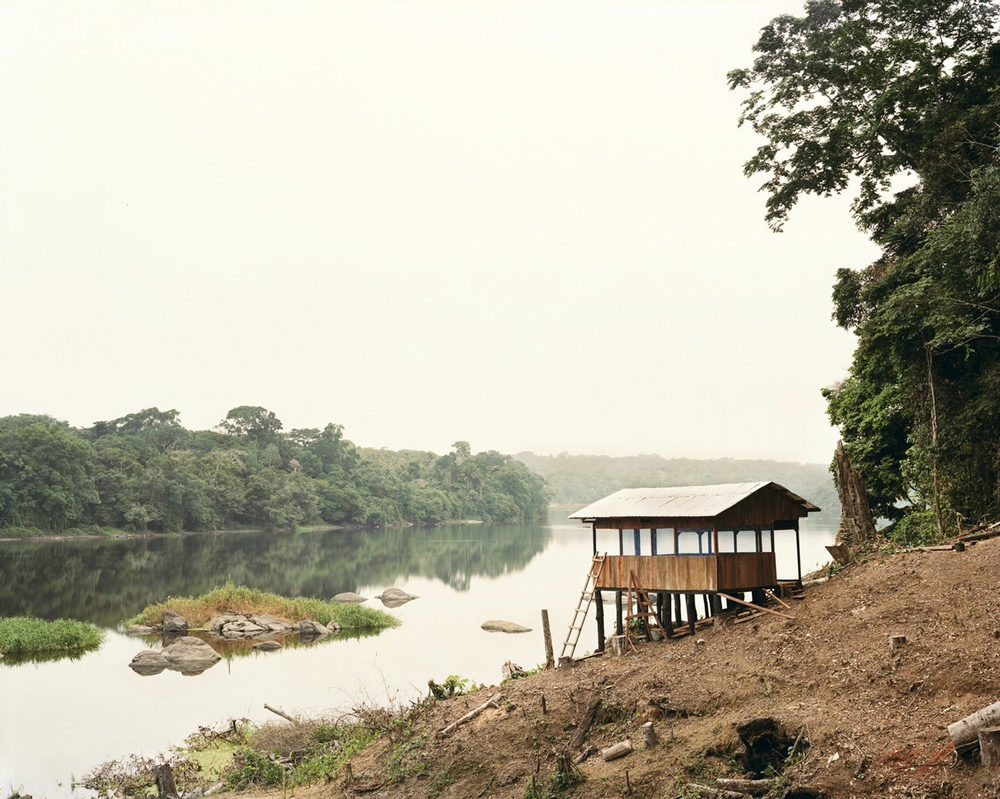
Between 1997 and 2003 I traveled to many developing countries in Central and South America, North Africa and Asia to make portraits of Western travelers. I was looking for both an escape from the West and a search for its alternative. However, whether I was in the remote Himalayas or the jungles of the Amazon, I found that the West was everywhere: in fast food restaurants, name brand products, movies, and the Western travelers themselves. Where are these people from? What brings them there? How is the place and the traveler altered by this exchange? Seeing how ubiquitous traveling has become, I decided it was a phenomenon worth addressing.
These portraits are set in places that are perceived to be unchanged by the modern age. The search for an untainted past is one of the reasons we travel there. We are, however, another link in a long chain of explorers, merchants, missionaries, and conquerors that have left an impact on these cultures. This conflicts with the noble aspirations that guide the traveler - the desire to learn through encounters with the unexpected. How does travel - an act of freedom - relate to the history of colonialism, of which it is a by-product?
All the photographs in this series are full-length portraits. There is both tension and ease in the way the traveler and the setting coexist. This work addresses the paradox of traveling as being both personally sublime and culturally profane. These portraits act as signposts; all the ideas are reduced to a simple record of people in a place where they don’t belong. I believe this work is significant not only because it is a record of travelers all over the world, but it also reverses the old discourse on us and them. It presents a neglected aspect of our culture in its contact with the mythical opposites of the Other.
All images copyright Sasha Bezzubov and Jessica Sucher; Sasha Bezzubov 1997 - 2011. An icompendium Site